
Legal transcription. Legal transcripts.
They sound like they should describe essentially the same work.
They don’t.
Producing a verbatim legal transcript is its own specialty. Whether someone is scoping for a stenographic or voice reporter or transcribing a recorded proceeding, the work requires far more than simply hearing words and typing them accurately.
Stenographic reporters — and many voice writers — often work with scopists. Digital reporters may instead work with legal transcriptionists or transcript editors. Both need specialized knowledge of verbatim legal transcripts.
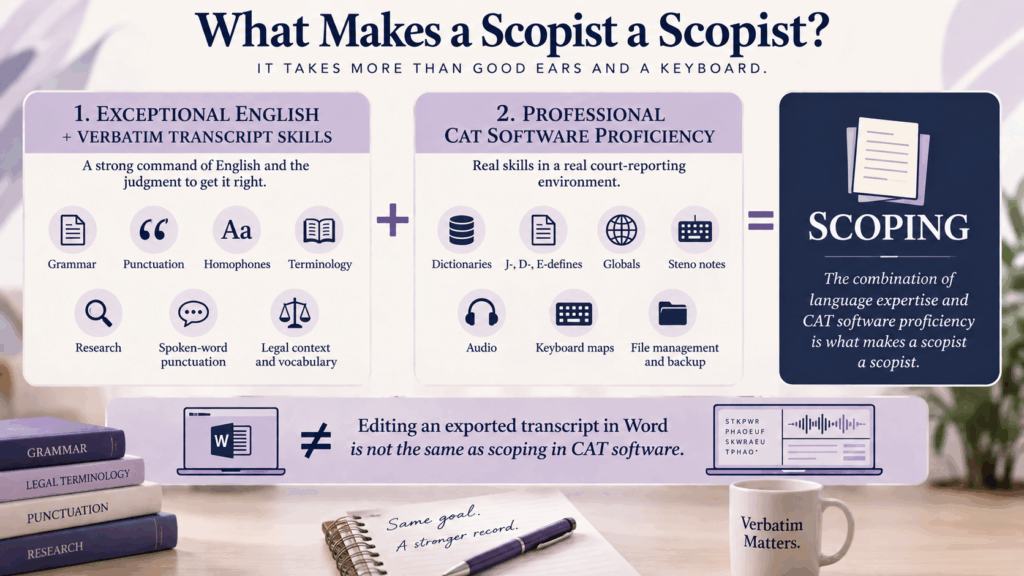
At its core, professional scoping requires two things: an exceptional command of English and knowing how to properly punctuate verbatim spoken language, and genuine proficiency in court-reporting CAT software.
That’s the distinction that sometimes gets lost.
A Scopist Needs Exceptional English Skills
Legal transcripts are filled with language that can look perfectly correct and still be wrong. Homophones, possessives, compound words, hyphenation, idioms, technical terminology, and punctuation all matter.
Consider these two versions of the same testimony:
RIGHT
“For all intensive purposes [sic], the patients’ follow-up care was the same — well, except that Dr. Harris ordered an X-ray of the ilium after the workplace accident. My counsel said the principal issue was whether the hospital’s decision-making violated the standard of care before the statute of limitations ran.”
WRONG
“For all intensive purposes, the patient’s follow up care was the same — well, except that Dr. Harris ordered an Xray of the ileum after the work place accident. My council said the principle issue was whether the hospital’s decision making violated the standard of care before the statue of limitations ran.”
The wrong version might not look particularly alarming. That’s exactly the problem.
Ilium and ileum are both real anatomical terms. Counsel and council, principal and principle, and statute and statue are all real words. Spellcheck isn’t going to save you.
A transcript professional has to know enough to recognize when something deserves a second look in the first place.
You can’t research what you don’t recognize as potentially wrong.
That’s why an exceptional command of English matters so much. A professional working on legal transcripts needs deep familiarity with grammar, punctuation, spelling, idioms, homophones, spoken syntax, and proper punctuation of verbatim testimony — plus the judgment to know when a medical term, company name, legal term, product, acronym, or seemingly ordinary word needs to be researched.
Resources such as Morson’s English Guide for Court Reporters, Margie Wakeman Wells’ Court Reporting: Bad Grammar/Good Punctuation, and The Gregg Reference Manual are commonly used in this field.
This expertise matters for both scopists and legal transcriptionists.
But for scopists, there’s another major skill set.
Scopists use CAT Software Proficiently
Court-reporting CAT software isn’t word-processing software.
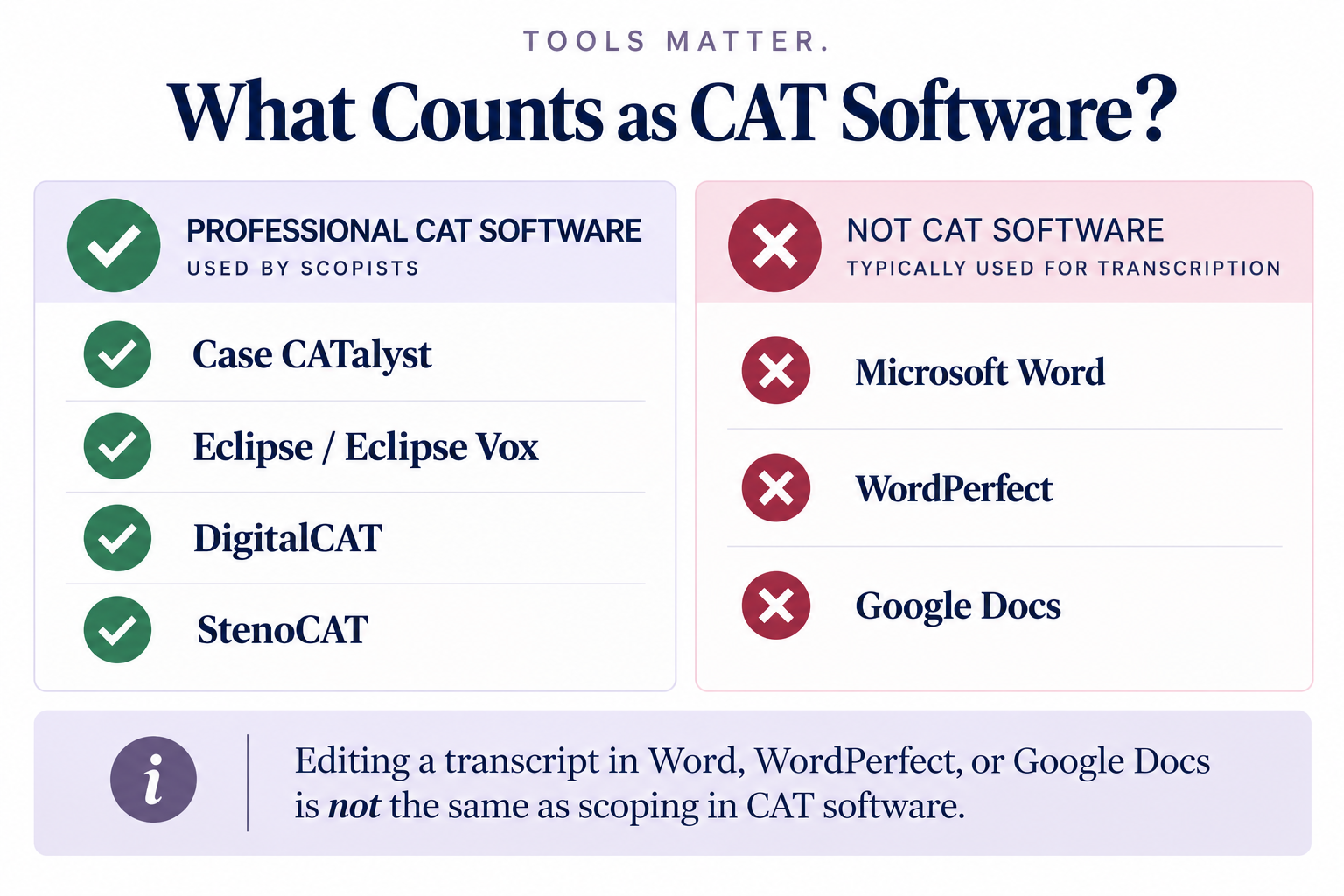
Stenographers and voice writers produce transcripts using professional CAT software and related tools such as Case CATalyst, Eclipse, Eclipse Vox, Dragon, DigitalCAT, StenoCAT, and others. A scopist needs to know how to work competently and efficiently within the reporter’s software—especially when using collaborative tools such as RealTeam or ConnectionMagic.
That means understanding the different types of dictionaries and when to use a J-, D-, or E-define; knowing how to global something correctly without creating problems elsewhere in the transcript; reading steno notes when necessary; working with audio; using keyboard maps and CAT-specific commands efficiently; handling speaker designations, Q&A, colloquy, and transcript formatting; and properly backing up and returning CAT files.
Those aren’t skills someone develops by editing transcripts in Microsoft Word.
Working on a transcript that came out of Case CATalyst is not the same thing as knowing how to scope IN Case CATalyst.
Professional CAT software also represents a significant investment. As of 2026, Case CATalyst Edit is listed at $1,899, and Eclipse Edit at $1,849.
So when a reporter asks, “What CAT software do you use?”, they’re asking which CAT platform you can actually sit down in and use proficiently.
If you do not own CAT software, be honest.
That’s information a reporter needs to determine whether your skills match the work they’re hiring you to do.
So Where Does Legal Transcription Fit?
This is where scoping vs. transcription can get confusing.
Legal transcription is a legitimate specialty, and experienced legal transcriptionists may already possess many of the skills that make a great scopist: exceptional English, careful listening, research, legal terminology, and experience producing verbatim transcripts.
Digital reporters, in particular, may work with legal transcriptionists or transcript editors to produce transcripts from recorded proceedings. Those professionals should be trained specifically in legal transcription; general transcription experience alone doesn’t equip them with the specialized demands of producing a legal transcript.
But if your experience has been producing transcripts from recordings or editing transcripts in Word, that experience doesn’t automatically give you the CAT skills a stenographer or voice writer expects when asking for a scopist.
That’s the difference.
If you’re already a skilled legal transcriptionist looking to become a scopist, you may have a strong foundation. You simply have another specialty to learn.
Interested in Becoming a Scopist?
If scoping is where you want to go, that’s absolutely something you can learn. Experienced legal transcriptionists may already bring strong English, research, listening, and transcript skills to the table. The next step is learning the CAT side of the profession.
Internet Scoping School and BeST Scoping Techniques are two established training options, and CAT software companies also offer training on their respective platforms.
While you’re learning, be clear about where you are in the process. If you’re an experienced legal transcriptionist learning Case CATalyst, say exactly that. If you’re training to become a scopist, say you’re a student scopist. And if you haven’t actually worked in Eclipse, don’t list Eclipse simply because you’ve edited Word documents that originated there.
Being new isn’t the problem. Representing experience you don’t yet have is.
Reporters know that new scopists need opportunities to become experienced scopists. Learn the software. Study English and legal transcript punctuation. Practice. Ask questions. Build the experience honestly.
Transcription Skills Have Value, Too
Transcription skills can open the door to work across an enormous range of fields. Transcriptionists work with podcasts, interviews, webinars, Zoom meetings, corporate meetings, market research, academic research, media productions, insurance statements, focus groups, and more.
Companies such as Rev, TranscribeMe, GoTranscript, and Scribie connect transcriptionists with this kind of work.
If transcription is where your experience lies, there is a much bigger world of opportunity than you may realize.
A Quick Note About Location
Legal transcripts often contain confidential or sensitive information, so some assignments may restrict where files can be accessed or where the work can be performed.
NCRA has specifically addressed the confidentiality and security implications of outsourced transcript work and notes that some jurisdictions regulate, restrict, or prohibit outsourcing judicial transcription, including concerns surrounding work performed outside the United States.
That doesn’t say anything about someone’s ability. It simply means transcript professionals should accurately represent their location and comply with the requirements of each assignment.
For Court Reporters: Look Beyond the Title
Someone calling themselves a scopist doesn’t automatically tell you whether they have the training and experience you expect.
Ask about their English and transcript knowledge, training, CAT proficiency, and the kinds of files they’ve actually worked on. Then let the other trust signals — identity, reviews, references when needed, communication, and actual work — help complete the picture.
We’ve covered that process in much more detail in How to Vet a Scopist or Proofreader Before You Hire.
Different Skills. Shared Goal.
Scopists and legal transcriptionists have more in common than the terminology sometimes suggests.
Both need an exceptional command of English, careful research habits, and the specialized knowledge required to properly punctuate and produce a verbatim legal transcript.
A professional scopist also needs genuine proficiency in court-reporting CAT software.
If you’re a transcriptionist who wants to become a scopist, you absolutely can with time and proper training. If you’re already a skilled legal transcriptionist, accurately represent the expertise you have. And if you’re a reporter hiring help, make sure the person’s training matches the work you’re asking them to do.
It’s not about protecting a title.
It’s about protecting the integrity of the record.
