
We spend a lot of time in the court reporting community talking about how to vet a scopist or proofreader before trusting someone with transcript files—and for good reason.
But scopists and proofreaders face a different risk when accepting work from someone new: How do you know the person contacting you is actually the court reporter they claim to be?
One particularly concerning court reporter impersonation scam being discussed in court reporting communities has an unsettling twist:
The transcript may be completely real. The “reporter” hiring you may not be.
How a Court Reporter Impersonation Scam Can Work
Someone contacts you claiming to be a court reporter who needs a scopist.
They send you the job: the transcript files, audio, and other materials you would normally expect. Everything looks legitimate because it is legitimate work.
You agree on a rate and deadline, do the work, and return the finished transcript.
Then you don’t get paid.
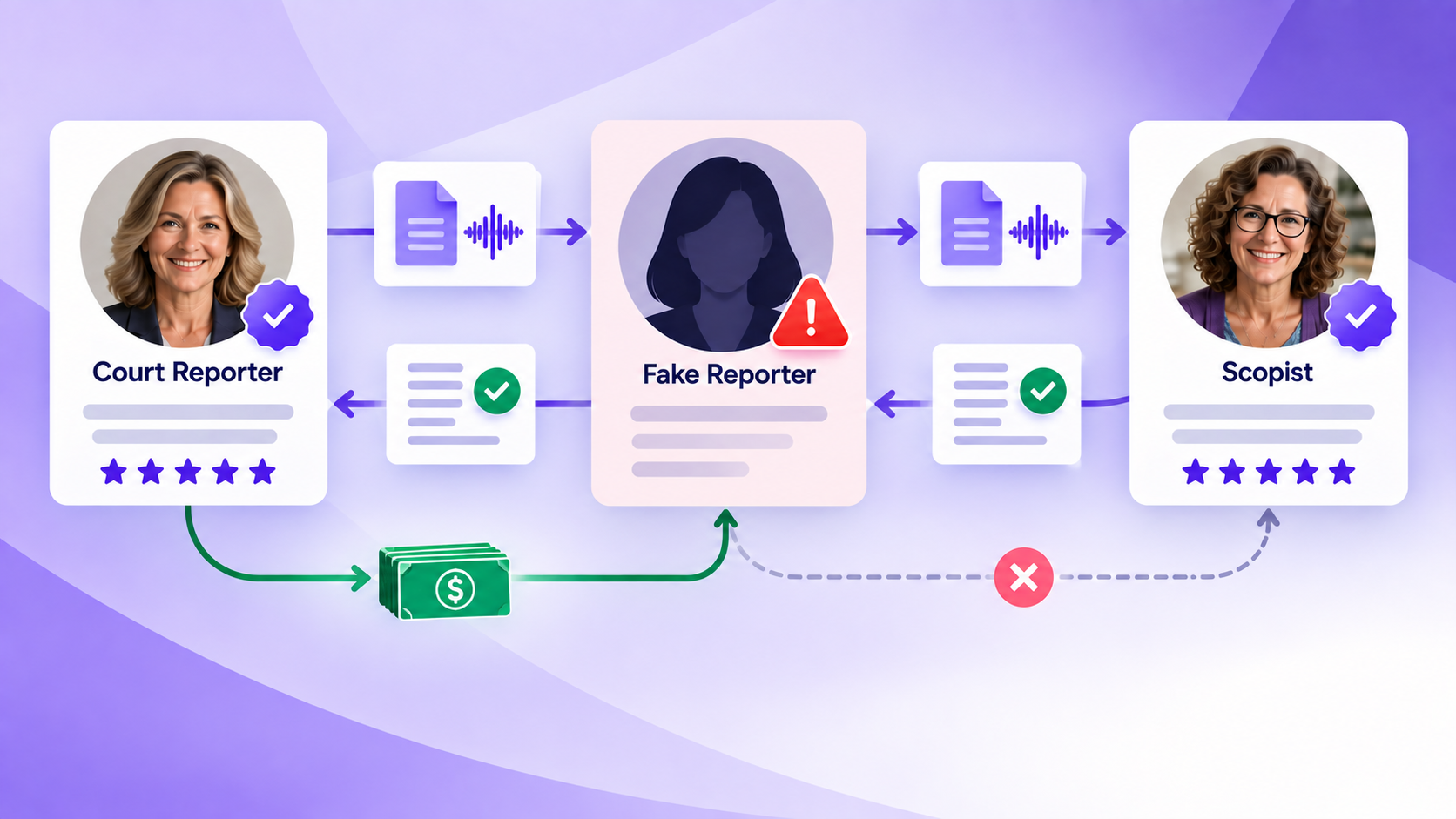
The person who hired you may actually be another transcript professional who received the job from the real reporter, handed the entire job off to you, did none of the actual scoping themselves, and then returned your completed work to the reporter as their own.
They get the completed transcript. They get paid by the reporter.
You did the work. You get nothing.
And there’s another question worth asking:
Did that person have permission to give you those files?
This isn’t only about protecting your paycheck. It’s also about knowing who you’re working with and whether the person sending you transcript files is actually authorized to share them with you.
“But I Looked Her Up. She’s a Real Reporter.”
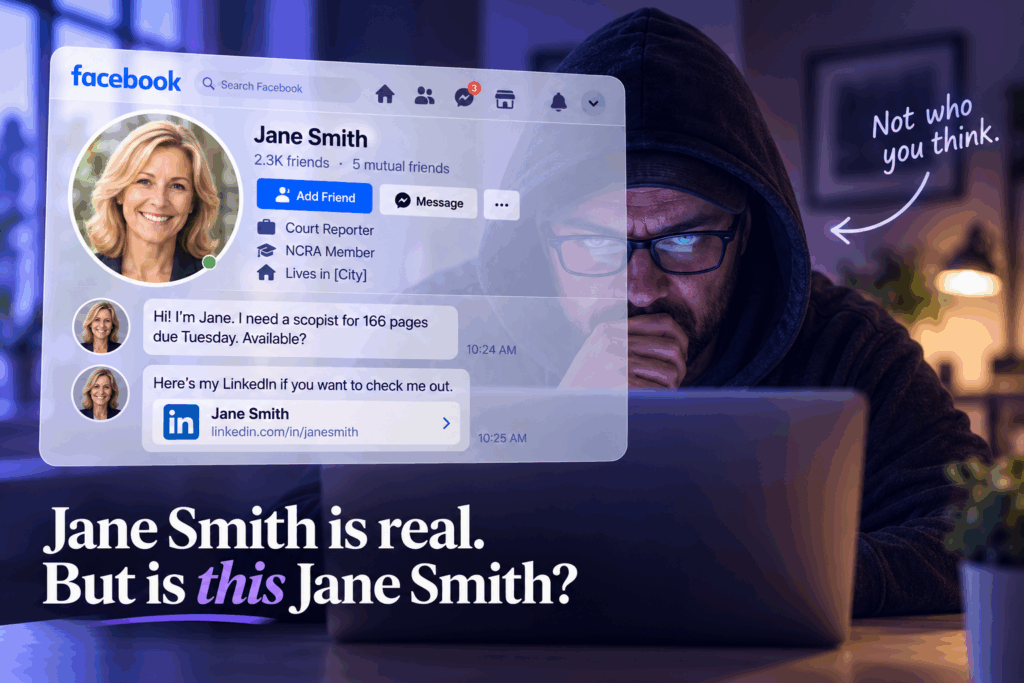
Let’s say you’re contacted by a reporter you’ve never worked with before. We’ll call her Jane Smith.
Before accepting the job, you do some homework. A quick search confirms that Jane Smith is, in fact, a court reporter. You find her license, a LinkedIn profile that matches, and maybe a company website, association listing, Facebook profile, or photos that give you even more confidence that she’s an established professional in the field.
Everything checks out.
Except there’s still one question you haven’t answered:
You’ve verified that Jane Smith is a real court reporter. You HAVE NOT verified that the person messaging you is Jane Smith.
An impersonator doesn’t need to invent a professional identity. They can simply borrow someone else’s.
A real reporter’s credentials, work history, location, and photos may already be publicly available—giving someone plenty of legitimate information to build a convincing fake profile.
You could research “Jane Smith” thoroughly and find nothing but accurate information. The problem is that all of it could belong to someone other than the person you’re talking to.
That’s what can make a court reporter impersonation scam particularly convincing: the person being impersonated may be completely legitimate.
Researching Someone and Verifying Their Identity Aren’t the Same Thing
Looking into someone’s professional background can tell you a lot. Licenses, ratings and reviews, references, work history, mutual connections, and conversations can all help you decide whether you want to work with someone.
But none of those things necessarily establish that the person communicating with you is the person whose professional history you’re researching.
That’s the gap identity verification is designed to fill.
“Fine. I’ll Make Them Get on Zoom!”
Actually, that’s a great idea.
If you’re considering working with someone new—especially someone you hope to work with regularly—a quick video call can add another layer of confidence. It can help establish that the person you’re talking to matches the professional identity you’ve found online, and it’s also a good way to start building an actual working relationship.
But does every new client need to start with a scheduled meeting?
Sometimes you’re accepting a last-minute job. Sometimes you’ll work with someone once and decide you’re simply not a good professional fit. And sometimes neither of you wants to coordinate calendars and schedule another Zoom call just to establish that you’re both real people.
A video call is a useful trust-building tool. It just isn’t an efficient identity-verification system.
“Great. Apparently I Need to Become a Private Investigator Before I Accept a 100-Page Job.” ????
No. Please don’t start requesting driver’s licenses from every reporter who messages you. (Really, please don’t do that — and don’t give random people your driver’s license either!)
The point isn’t that you should personally investigate every new client more thoroughly. It’s that establishing someone’s identity shouldn’t have to depend entirely on how much time you’re willing to spend researching them, comparing profiles, scheduling calls, and piecing together clues yourself. Who has the time and energy for that?
That’s exactly why professional identity-verification tools exist: so ordinary professionals don’t have to become identity investigators themselves.
What Professional Identity Verification Adds
Here’s the simplest way to think about it:
Google can help you confirm that Jane Smith exists. Professional identity verification is designed to help confirm that the person completing verification is Jane Smith.
Stenovate uses Stripe Identity for identity verification. We chose Stripe intentionally rather than building our own system for handling identity documents. Stripe is a global technology company trusted by millions of businesses, including Amazon, Google, and Zoom.
When you complete identity verification through Stenovate, Stripe handles the actual identity-verification process—including evaluating your government-issued ID and confirming that you match the person pictured on it. You aren’t sending a copy of your ID to the Stenovate team for us to review or verify ourselves.
Identity verification involves sensitive information, and we’d much rather rely on technology built specifically for that purpose than ask our members—or individual reporters and scopists—to handle it themselves.
That’s why a verified identity badge on Stenovate means something different from simply finding a matching professional profile online: that member successfully completed Stenovate’s identity-verification process through Stripe.
Identity verification establishes identity. It isn’t a substitute for vetting someone’s professional experience or reliability.
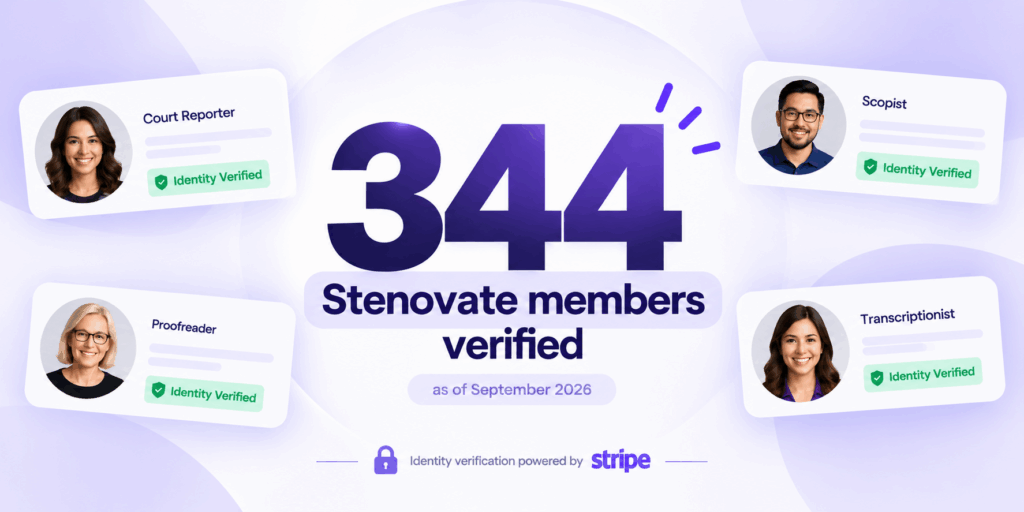
As of September 2026, 344 Stenovate members have successfully completed identity verification through Stripe.
(Not on Stenovate yet? Join the court reporting community, build your professional profile, and work with greater confidence. Your first 30 days are free. Join Stenovate!)
What Identity Verification Actually Looks Like
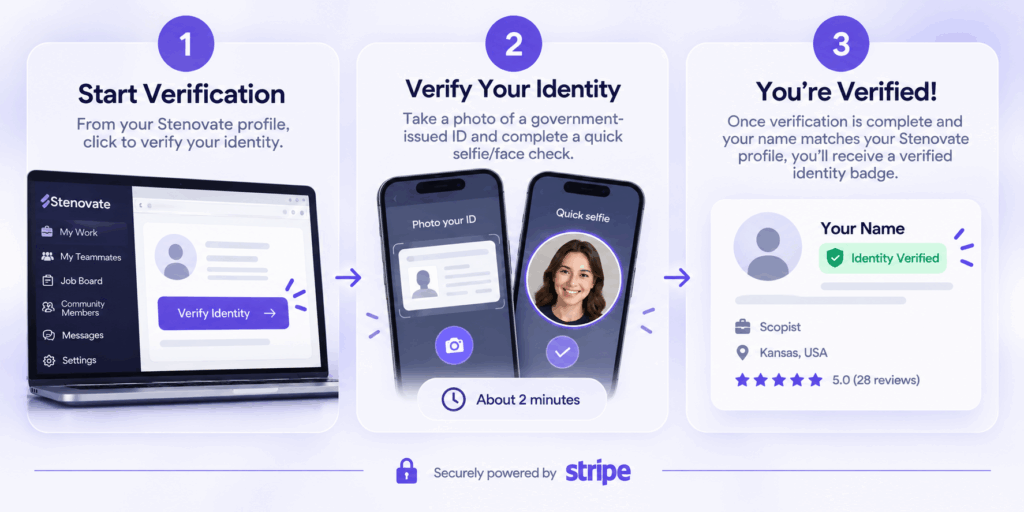
The process is surprisingly simple and typically takes just a couple of minutes. From your Stenovate profile, you’ll start verification with Stripe Identity. Stripe will walk you through taking a photo of an accepted government-issued ID and completing a quick selfie/face check to confirm that you match the person pictured on the ID.
That’s it. There are no forms to fill out, no documents to email to Stenovate, and no Zoom call to schedule with our team—or anyone else.
Once Stripe successfully verifies your identity and your name matches your Stenovate profile, your account receives the green Identity Verified badge—giving other members another useful trust signal before they work with you, or you work with them.
So What Should You Do When Someone New Sends You Work?
You don’t need to treat every new reporter like a potential scammer. But when someone you’ve never worked with contacts you, pay attention to whether the information you’re receiving is consistent with what you can independently confirm.
A phone or video conversation can add another layer of confidence. If you’re connecting through Stenovate, look for the green Identity Verified badge, then use the member’s profile, ratings and reviews, location, and professional information to help evaluate the rest of the relationship.
And especially with a brand-new client, be thoughtful about how much unpaid work you’re willing to have outstanding while you’re still establishing the relationship.
With court reporter impersonation scams, remember that no single piece of information tells you everything you need to know about another professional. Identity verification simply answers one particularly important question: Is this person actually who they say they are?
Reporters, This Goes Both Ways
Court reporters absolutely need to know who’s receiving their transcript files. We wrote an entire guide about that: How to Vet a Scopist or Proofreader Before You Hire.
But scopists and proofreaders deserve to know who’s hiring them, too.
Good professional relationships require trust in both directions.
So the next time someone new contacts you with a transcript, remember:
The transcript may be real. The court reporter whose name they gave you may be real. Their license, LinkedIn profile, and professional history may all be real.
But is the person on the other side of the screen really them?
That’s the piece worth verifying.
